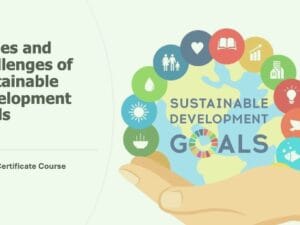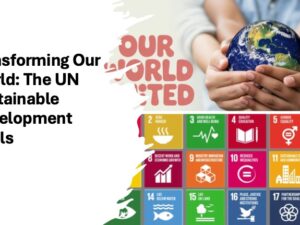
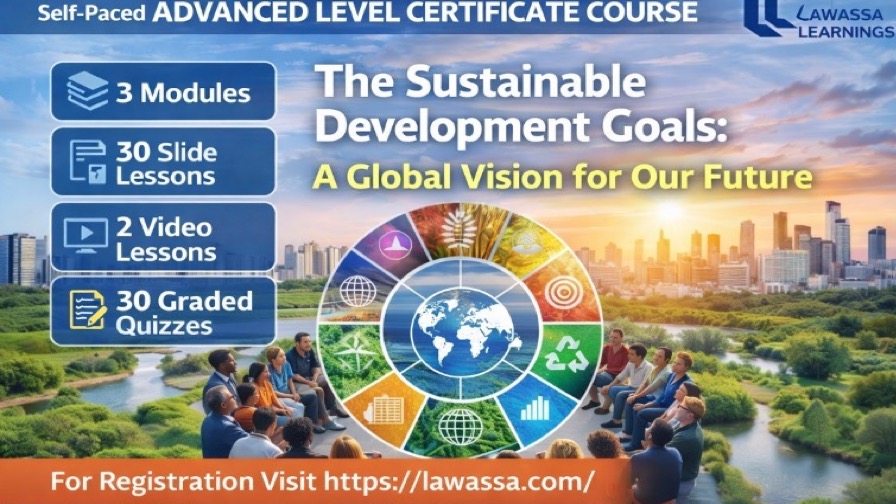
The Sustainable Development Goals (SDGs), adopted by the United Nations in 2015, represent a bold and ambitious global blueprint for achieving a more equitable, inclusive, and sustainable future by 2030. Comprising 17 goals and 169 interlinked targets, the SDGs address the most pressing challenges of our time—ranging from poverty eradication, gender equality, and quality education to climate action, sustainable cities, and peace and justice. Rooted in the principle of “leaving no one behind,” the SDGs aim to ensure that development benefits all segments of society, especially the most vulnerable. The SDGs embody a transformative vision that transcends traditional development paradigms by integrating economic growth, social well-being, and environmental stewardship. Unlike previous global agendas, the SDGs are universal in scope, applicable to all nations—developed and developing—and call for collaborative action across governments, civil society, the private sector, and individuals. They encourage multi-stakeholder partnerships, innovative financing mechanisms, and evidence-based policymaking to accelerate progress. Moreover, the SDGs emphasize the interconnectedness of global issues, recognizing that challenges such as poverty, climate change, inequality, and environmental degradation are interdependent and must be addressed holistically. For example, improving access to quality education (Goal 4) can empower individuals, reduce inequality (Goal 10), and contribute to economic growth (Goal 8). Similarly, climate action (Goal 13) is essential for protecting ecosystems and sustaining livelihoods. As the world navigates complex crises—including pandemics, conflicts, and ecological breakdowns—the SDGs remain a vital moral and strategic compass. They serve not only as a roadmap for sustainable development but also as a shared global vision of hope, resilience, and human dignity. Realizing this vision demands unwavering political will, sustained commitment, and inclusive action from all sectors of society to create a just, prosperous, and sustainable world for current and future generations.

Introduction
Agenda: Our Journey Through the SDGs
From MDGs to SDGs: The Evolution of Global Development
Key Principles: Leaving No One Behind
The Five Pillars of Sustainable Development
Overview: The 17 Sustainable Development Goals
SDGs 1–4: Basic Human Needs
SDGs 5–6: Inclusion and Basic Resources
SDGs 7-9: Infrastructure and Innovation
SDGs 10-12: Equality and Responsible Consumption
SDGs 13-15: Environmental Protection
SDGs 16-17: Peace and Partnership

Measuring Progress: The Framework of Targets and Indicators
Current Progress: Global Snapshot
Regional Variations in SDG Implementation
Case Study: Nordic Leadership in SDG Implementation
Challenges in SDG Implementation
The Impact of COVID-19 on SDG Progress
Building Back Better: SDGs as a Recovery Framework
SDG Localization: From Global Goals to Local Action

Summary: The Sustainable Development Goals A Global Vision for Our Future - Part I
Financing the SDGs: Bridging the Investment Gap
Technology and Innovation for the SDGs
The Role of Business in Advancing the SDGs
Climate Action: The Lynchpin SDG
SDGs and Social Justice: Leaving No One Behind
Educational Approaches for SDG Implementation
Measuring What Matters: Beyond GDP
Future Directions: SDGs 2.0 and Beyond
Personal Engagement: Becoming an SDG Champion
Conclusion: Our Shared Journey to 2030 and Beyond
Summary: The Sustainable Development Goals A Global Vision for Our Future - Part II
The Sustainable Development Goals: A Global Vision for Our Future with 3 Modules, 30 slide Lessons; 2 Video Lessons and 30 Graded Quizzes.
Instruction for Quiz:
• Students are strongly encouraged to thoroughly review the course materials, as the majority of quiz questions are directly based on the provided content.
• A minimum score of 80% in the graded quiz of each module is mandatory to earn the course completion certificate.
• Learners are granted a minimum of Three attempts to successfully complete the intermediate level certificate course.
• In the event of a retake, students are advised to revisit the course content carefully to strengthen their understanding and improve their performance.
• Should a student fail to complete the course within the allotted Three attempts, repurchasing the course will be necessary to obtain the desired intermediate-level certificate.
This advance certificate course is specifically designed for learners who seek a deep and comprehensive understanding of advanced concepts, and it is therefore most suitable for individuals who already possess a strong foundational background in the subject. Participants are expected to have acquired prior knowledge at both the basic and intermediate levels, which will serve as a critical prerequisite for engaging meaningfully with the material presented. The content structure assumes familiarity with essential terminologies, conceptual frameworks, and fundamental principles. Learners without this preparatory knowledge may find it challenging to grasp the more nuanced and complex dimensions discussed throughout the course. Hence, to maximize the learning experience and ensure intellectual continuity, it is imperative that participants approach this advanced module with the requisite academic grounding. This approach enables a focused exploration of intricate themes and fosters critical thinking, analytical depth, and the ability to apply theoretical insights to practical and policy-related contexts.