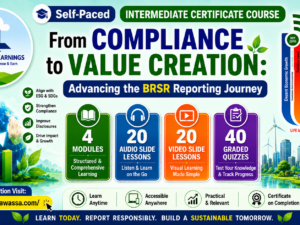

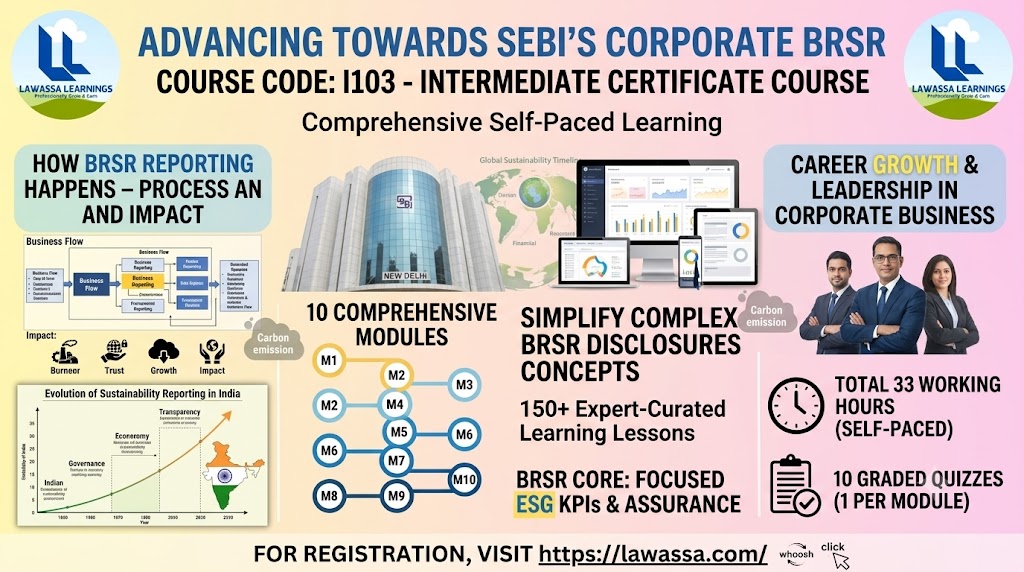
Elevate your professional trajectory with LAWASSA LMS’s Advanced Certificate Course in Business Responsibility and Sustainability Reporting (BRSR). As environmental, social, and governance (ESG) reporting shapes the corporate landscape, expertise in this framework offers a definitive professional asset. Mandated by SEBI, the BRSR framework requires transparent sustainability disclosures. Meticulously crafted by Dr. Harshit Sinha, a veteran with over three decades of experience, this self-paced, 10-module program delivers 150 curated lessons and 10 graded assessments, totalling 30 flexible working hours. Secure an Advanced Certificate with an 80% passing score, demonstrating mastery in critical corporate governance and sustainable finance domains.

Introduction to the course
1 : Understanding about The Committee on BRSR
3: The Philosophy of Responsible Business
4: Context – A Report Amid a Global Pandemic
5: From NVGs to NGRBC – The Evolution
6: Shifting the Purpose of Business
7: Preface – Key Recommendations at a Glance
8: Financial Reporting – The Traditional Focus
9: Environmental & Social Reporting – A Different Trajectory
10: The Business Case for Sustainability Reporting
11: Seven Benefits of Sustainability Reporting
12: Demonstrating Leadership
13: Global Sustainability Reporting Frameworks
14: More Global Frameworks
15: Global Trends – Mandatory Sustainability Reporting
16: Non-Financial Reporting in India

Summary & Key take away: Module 1

Introduction to Module 2
1: The IICA Study – Methodology
3: Principle-wise Response Analysis
4: Implications for the Proposed Formats
5: Nature of Formats – Deliberations & Recommendations
6: What Makes BRSR Unique
7: Staggered Applicability
8: Recommendation I – The BRSR Framework
9: Essential vs. Leadership Indicators
10: BRSR Lite – For Smaller Companies
11: Recommendations II & III – Phased Implementation and MCA21 Integration
12: The Growing Salience of Non-Financial Disclosures
13: MCA21 Integration – The First Step
14: Vision – Business Responsibility-Sustainability Index
15: Capacity Building and Implementation Timeline
16: Sector-Specific BRSR Formats
17: Module 2 - Summary & Key Learnings
Introduction to Module 3
1: BRSR Format – Section A: General Disclosures
2: Section A – Company Details & Products
3: Section A – Operations & Location Categories
4: Section A – Employees & Workforce Data
5: Section A – Subsidiaries, CSR Activities and Transparency
6: Section B – Management and Process Disclosures
7: Section C – Principle 1: Ethics, Transparency and Accountability
9: Section C – Principle 3: Employee Well-being and Workforce Development
10: Principle 3 – Leadership Indicators
11: Principles 4 and 5 – Stakeholder Responsiveness and Human Rights
12: Principle 6 – Environmental Stewardship and Resource Efficiency
13: Principles 7, 8 and 9 – Public Policy, Inclusive Growth and Consumer Value
14: Module 3: Summary & Key points
Introduction to Module 4
2: Structure of the BRSR Format
3: Guidance Note – Section A Key Definitions
4: Industry Associations – Annexure A
6: Section C – Principle-wise Performance Disclosures: Essential vs Leadership Indicators
7: Guidance Note – Section B & C Key Definitions
8: Guidance Note – Principle 3 Definitions
9: Deep Dive – Environmental Principles (Principles 2 & 6)
10: Deep Dive – Social Principles (Principles 3, 4, 5 & 8)
11: Value Chain Disclosures
12: BRSR Core & Assurance Requirements
13: The Nine NGRBC Principles at a Glance
14: Make in India – Responsibly
14: Module 4: Summary & Key Points
Introduction to Module 5
1: Business Responsibility & Sustainability Reporting (BRSR)
2: What is BRSR?
3: Course Contents
4: Section I – General Guidance
5: Inter-operability of Reporting Frameworks
6: Reporting Boundary, Applicability & Key Definitions
7: The BRSR Reporting Architecture
8: Section A – Business Activities & Products
9: Details of Employees and Workers.
10: Women Representation & Employee Turnover Rate
11: Holding, Subsidiary, Associate Companies & Joint Ventures
12: Grievance Redressal Mechanism & Material Sustainability Issues
13: Section B – Management & Process Disclosures
14: Commitments, Goals & Targets
15: Director's ESG Statement & Highest Authority for Policy Implementation
16: Module 5: Summary & Key Points
Introduction to Module 6
1: Introduction to BRSR –Principles 1–3
2: Principle 1 – Ethics, Transparency & Accountability
3: Principle 1 – Essential Indicators
4: Principle 1 – Leadership Indicators
5: Principle 2 – Sustainable Products & Services
6: Principle 2 – Essential Indicators
7: Principle 2 – Leadership Indicators
8: Principle 2 Leadership Guidance – Life Cycle Assessment, Recycled/Reused Materials & Reclaimed Products
9: Principle 3 – Employee Well-being
10: Principle 3 – Essential Indicators (Part A)
11: Principle 3 – Well-being, Accessibility & Parental Leave
12: Principle 3 – Essential Indicators (Part B)
13: Principle 3 – Training, Performance Reviews & Occupational Health and Safety
14: Principle 3 – Safety Incidents & Workplace Measures
15: Principle 3 – Leadership Indicators
16: Summary & Key Points
1: Introduction – Business Responsibility & Sustainability Reporting (BRSR)
2: Principle 4 – Stakeholder Engagement
3: Principle 4 – Essential Indicators
4: Principle 4 – Leadership Indicators
5: Principle 5 – Human Rights
6: Principle 5 – Essential Indicators
7: Principle 5 – Wages Definition (Code on Wages, 2019)
Principle 5 – Q.6: Complaints on Human Rights Issues
9: Principle 5 – Leadership Indicators
10: Module 7: Summary & Key Points
1: Principle 6 – Environment
2: Principle 6 – Essential Indicators: Energy
3: Principle 6 – Q.1: Energy Consumption & Intensity
4: Principle 6 – Essential Indicators: Water & Waste
5: Principle 6 – Q.3: Water Withdrawal, Consumption & Intensity
6: Principle 6 – Waste Management, Biodiversity, Compliance, GHG Emissions & Leadership Indicators
7: P6 — Essential Indicators: Biodiversity & Compliance
8: Principle 6 — Q.6: GHG Emissions (Scope 1 & 2)
9: Principle 6 — Leadership Indicators: Renewable Energy, Water Discharge & Scope 3
0: Introduction to Module 9
1: Introduction to BRSR – Essential & Leadership Indicators Across Principles 7–9
2: Principle 7: Policy Advocacy
3: Principle 7 – Essential Indicators
4: Principle 7 – Leadership Indicators
5: Principle 8: Inclusive Growth & Equitable Development
6: Principle 8 – Essential Indicators
7: Principle 8 – Leadership Indicators
9: Principle 9: Consumer Responsibility
10: Principle 9 – Essential Indicators
14: Essential vs Leadership: A Comparative View
15: Summary: The Nine NGRBC Principles at a Glance
16: Key Takeaways for BRSR Compliance
Module 9: Summary & Key Points
1: Onward Roadmap of BRSR for Implementation at Corporate Office
2: BRSR & Global ESG Frameworks
3: Implementation Roadmap for BRSR
4: Common Challenges in BRSR Implementation
5: BRSR & Investor Expectations
6: Sector-Specific BRSR Considerations
7: The Role of the Board in BRSR
8: BRSR Assurance Framework
9: Key Performance Indicators Dashboard
11: The Future of BRSR
12: Key Takeaways & Call to Action
Module 10: Summary & Key Points
Welcome to this Advanced Certificate Course on Business Responsibility and Sustainability Reporting (BRSR), meticulously curated for professionals navigating modern corporate governance. This comprehensive curriculum seamlessly transitions learners from foundational tenets to complex practical application within India’s intricate regulatory framework.
The pedagogical journey commences with critical context in Modules 1 and 2, dissecting the seminal CBRR, tracking the crucial shift from NVGs to NGRBC, and addressing historical disclosure gaps to emphasise the imperative for BRSR’s robust architecture and technological integration. The curriculum then initiates a technical deep dive. Modules 3 and 4 analyze the BRSR Framework’s three pivotal pillars—covering general, management, and performance disclosures—and provide a masterful interpretation of SEBI’s Guidance Note regarding Essential versus Leadership indicators and value chain reporting.
Modules 5 through 9 synthesise prescriptive requirements with rigorous operationalisation. Participants will explore requisite ESG governance structures, board oversight responsibilities, and the specific application of NGRBC principles ranging from ethical governance and sustainable product stewardship to human rights, rigorous environmental metrics (including emissions and climate risk), and consumer responsibility. The program culminates strategically in Module 10, a definitive guide to institutionalising BRSR, managing complex ESG data systems, and aligning Indian disclosures with global standards for long-term sustainable value creation.
Instructions:
The Advanced Certificate Course on Advancing towards SEBI's Corporate Business Responsibility and Sustainability Reporting (BRSR) Framework is designed for industry professionals, ESG practitioners, sustainability leaders, compliance officers, consultants, and business executives engaged across diverse levels of organisational management. The programme offers an in-depth understanding of SEBI's BRSR Framework, emphasising the integration of sustainability into corporate governance, strategic decision-making, and responsible business conduct. Participants will explore the three foundational pillars of sustainability—Stakeholder Engagement, Human Rights, and Environmental Stewardship—anchored within the Nine Principles of the National Guidelines on Responsible Business Conduct (NGRBC). The course critically examines governance systems, stakeholder collaboration, transparency, accountability, and cross-sector partnerships while aligning sustainability disclosures with globally recognised ESG reporting frameworks. Through real-world case studies, practical analytical tools, and strategic implementation methodologies, learners will strengthen their capabilities to develop robust BRSR reporting practices, enhance regulatory compliance, foster stakeholder confidence, and drive long-term sustainable value creation and corporate resilience.
This advanced certificate course on Advancing towards SEBI’s Corporate BRSR is designed for industrial professionals working at various level of hierarch of business operations that are involved field experience in partnership-driven sustainable development interventions. It offers an intensive exploration of the complex architecture of global cooperation, focusing on the mechanisms that strengthen multi-stakeholder partnerships essential for achieving the ESG Agenda of our country. The programme delves into advanced frameworks for mobilising BRSR framework focuses on three critical pillars of sustainability: Stakeholder Engagement, Human Rights, and Environmental Stewardship, with Nine National Guidelines on Responsible Business Conduct (NGRBC) business Principle.
Learners will critically examine governance systems, international cooperation dynamics, and innovative partnership models that bridge transparency accountability, cross-sector alignment, and long-term sustainable disclosure aligning with international standards disclosure framework.
By engaging with real-world case studies, analytical tools, and strategic design approaches, professionals are encouraged to refine their capabilities and contribute to more effective, equitable, and resilient global partnerships—thereby advancing the transformative ambitions India’s SEBI’s BRSR framework.