
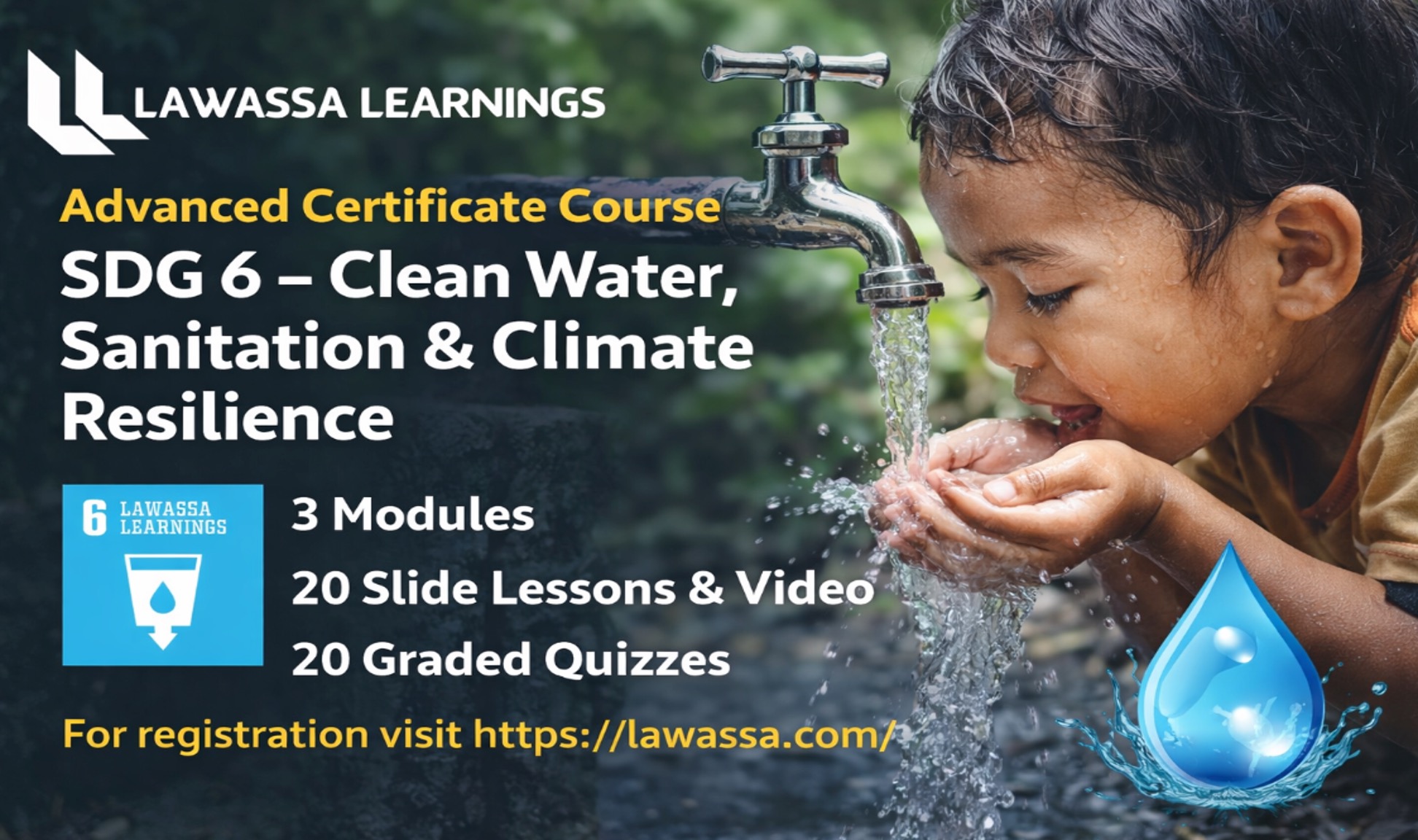
Sustainable Development Goal 6 stands as one of the most vital pillars of global well-being, safeguarding universal access to clean water, safe sanitation, and resilient water-resource management. As climate pressures intensify, populations expand, and water ecosystems deteriorate, the pursuit of SDG 6 becomes a defining challenge for sustainable development worldwide. Despite notable advancements, millions still lack reliable drinking water, adequate sanitation, and hygienic living conditions, resulting in preventable disease burdens and persistent social inequities.
The Advanced Certificate Course on SDG 6: Clean Water and Sanitation is tailored for professionals and development practitioners with a strong foundational background who seek to enhance their technical and analytical expertise. The programme offers an in-depth understanding of integrated water-resource management, WASH systems, policy frameworks, and innovative technologies that drive sustainable water and sanitation solutions.
In the Indian context, initiatives such as Jal Jeevan Mission and Swachh Bharat Abhiyan have significantly expanded coverage, yet operational sustainability, water quality concerns, and behavioural challenges persist. This course equips learners to interpret indicators, design evidence-based interventions, and evaluate programme effectiveness in both global and national settings.
Join this advanced learning journey to strengthen your capacity to create measurable, transformative impact and contribute meaningfully to achieving SDG 6 for all.

1: Introduction
2: Understanding SDG 6: Clean Water and Sanitation
3: Why Clean Water and Sanitation Matter?
4: Global Water and Sanitation Crisis
5: Global Water Challenges: Regional Disparities
6: Water Conflicts: Growing Security Threat

7: Climate Change: The Water Crisis Multiplier
8: India’s Water and Swachh Bharat Mission
9: Sanitation Challenges in India
10: Sanitation Innovations: Beyond Traditional Approaches
11: Challenges to Clean Water Access in India
12: Innovative Solutions: Water Conservation Technologies
13: Community-Led Water and Sanitation Success Stories
14: Financing the Water and Sanitation Gap
15: The Path Forward: Accelerating Progress on SDG 6
16: The Eight Targets of SDG 6
17: Advanced Targets and Global Cooperation for SDG 6
18: Indicator-Based Impact Assessment Framework for SDG 6
19: Key Performance Indicators for SDG 6
20: The Path Forward: Achieving SDG 6 by 2030

Summary:
Clean Water and Sanitation: Achieving S D G 6 Globally and in India
The pursuit of Sustainable Development Goal 6 (SDG 6) constitutes a pivotal global endeavour to uphold one of humanity’s most essential rights: equitable access to safely managed water and sanitation. This aspiration extends beyond conventional infrastructure provision, embracing the broader mandate of sustainable water-resource governance to secure dignity, resilience, and intergenerational equity. SDG 6 serves as a foundational enabler of multiple development priorities, underpinning public health, poverty alleviation, gender equality, climate resilience, and economic productivity.
Yet the global trajectory toward universal access by 2030 remains fraught with complexity. Despite measurable progress, billions continue to lack safe drinking water, adequate sanitation, and hygiene services, with the starkest disparities concentrated in sub-Saharan Africa and parts of Asia. Climate change, groundwater depletion, pollution, and rapid urbanisation further intensify these vulnerabilities, necessitating innovative, integrated, and climate-resilient solutions.
India exemplifies both the magnitude of the challenge and the potential for large-scale transformation. Landmark initiatives such as Swachh Bharat Abhiyan have significantly expanded sanitation coverage and curbed open defecation. However, the next frontier lies in ensuring long-term functionality, water-quality assurance, wastewater management, and sustainable behaviour change. Advancing SDG 6 in India demands strengthened governance, sustained investment, community stewardship, and the adoption of modern technologies. Only through such comprehensive and disciplined efforts can the promise of SDG 6 be realised as a durable and inclusive achievement.
Instructions:
This Advanced Certificate Course on SDG 6 is designed for learners with substantial prior knowledge and professional field experience in clean water and sanitation interventions. The programme offers a rigorous exploration of advanced concepts in water-resource governance, WASH systems, water-quality monitoring, and sustainable sanitation solutions. Participants will engage with sophisticated analytical frameworks, global indicator systems, and evidence-based methodologies essential for enhancing programme effectiveness and strengthening SDG 6 outcome indicators.
The course delves deeply into challenges such as water scarcity, wastewater management, climate-related vulnerabilities, and long-term system sustainability. Through case-based learning and technical modules, learners will refine their ability to design resilient interventions, assess operational functionality, and implement community-centred strategies that promote sustained behaviour change.
This advanced course invites committed professionals seeking to elevate their expertise and contribute to measurable, transformative progress in achieving universal access to clean water and sanitation, thereby advancing the global SDG 6 agenda.