Environmental, Social, and Governance (ESG) frameworks have emerged as pivotal tools in aligning economic activities with sustainable development imperatives. In the context of a developing economy like India, ESG implementation presents both significant opportunities and formidable challenges. India’s rapid industrial growth, demographic pressures, and developmental priorities often conflict with environmental and social sustainability goals. The ESG framework broadly comprises three dimensions: Environmental—concerned with climate risk, resource efficiency, and pollution control; Social—focused on labour rights, community engagement, health, and safety; and Governance—emphasising transparency, board diversity, ethical conduct, and regulatory compliance. In a developing economy, operationalizing these pillars often demands a delicate balance between growth aspirations and long-term sustainability. India faces several structural challenges in institutionalizing ESG. Firstly, there is a lack of standardised metrics and reporting frameworks suitable for local contexts. Secondly, small and medium enterprises (SMEs)—which constitute the backbone of the Indian economy—often lack the financial and technical capacity to adopt ESG protocols. Furthermore, regulatory enforcement remains inconsistent, and ESG disclosures are often superficial or driven by compliance rather than genuine commitment. Social inequalities, informal labor practices, and environmental degradation further complicate the effective adoption of ESG. While the Securities and Exchange Board of India (SEBI) has introduced the Business Responsibility and Sustainability Reporting (BRSR) framework for the top listed companies, broader adoption remains limited. A comprehensive and inclusive ESG ecosystem in India requires sector-specific guidelines, capacity-building for SMEs, robust regulatory mechanisms, and the integration of ESG into mainstream development policies.

Introduction to Topic
Giving Meaningful Meaning for ESG
The Beginning: The Rising Demand of ESG
Context of Paris Agreement (2015)
Existing main reporting frameworks and standards for ESG reporting
Comparative Analysis of Existing ESG Framework
SIX Major Issues About ESG
Missing Link for ESG in INDIA
Summary Points of Module 1

India's ESG Awakening: Embracing a Framework for Sustainable Growth
Existing of different types of Laws in India
Main Approaches for Actionable ESG Strategies
Major Classification of Interventions done under UN SDGs indicators
Mapping Impact: How ESG Links to the UN SDGs
Unlocking New Opportunities: India's Upcoming ESG Scheme
Explaining Probable Framework – ESG(FE)
Continue.. Probable Framework – ESG(FE)
Summary Point of Module 2
Value Creation of ESG(FE) Framework
Continue Value Creation of ESG(FE) Framework
Exploring ESG(FE) Framework with Probable Scorings
Matrix Composition for Evaluation of Industries under ESG Framework
Conti… Matrix Composition for Evaluation of Industries under ESG Framework
Matrix Composition for Evaluation of Industries under ESG Framework
Operational Challenges of ESG(FE)
Summary Points for Module 3
27 Summary: Video Preview
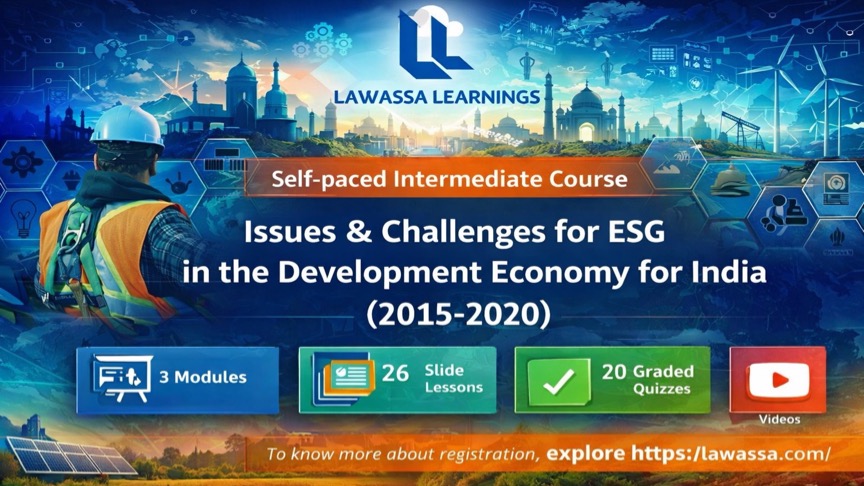
Issues & Challenges for ESG in the Development Economy for India (2015-2020)covers 3 Modules, 26 Slide lessons with videos and 20 Graded Quizzes
Instruction for Quiz
This advance certificate course is specifically designed for learners who seek a deep and comprehensive understanding of advanced concepts, and it is therefore most suitable for individuals who already possess a strong foundational background in the subject. Participants are expected to have acquired prior knowledge at both the basic and intermediate levels, which will serve as a critical prerequisite for engaging meaningfully with the material presented. The content structure assumes familiarity with essential terminologies, conceptual frameworks, and fundamental principles. Learners without this preparatory knowledge may find it challenging to grasp the more nuanced and complex dimensions discussed throughout the course. Hence, to maximize the learning experience and ensure intellectual continuity, it is imperative that participants approach this advanced module with the requisite academic grounding. This approach enables a focused exploration of intricate themes and fosters critical thinking, analytical depth, and the ability to apply theoretical insights to practical and policy-related contexts.