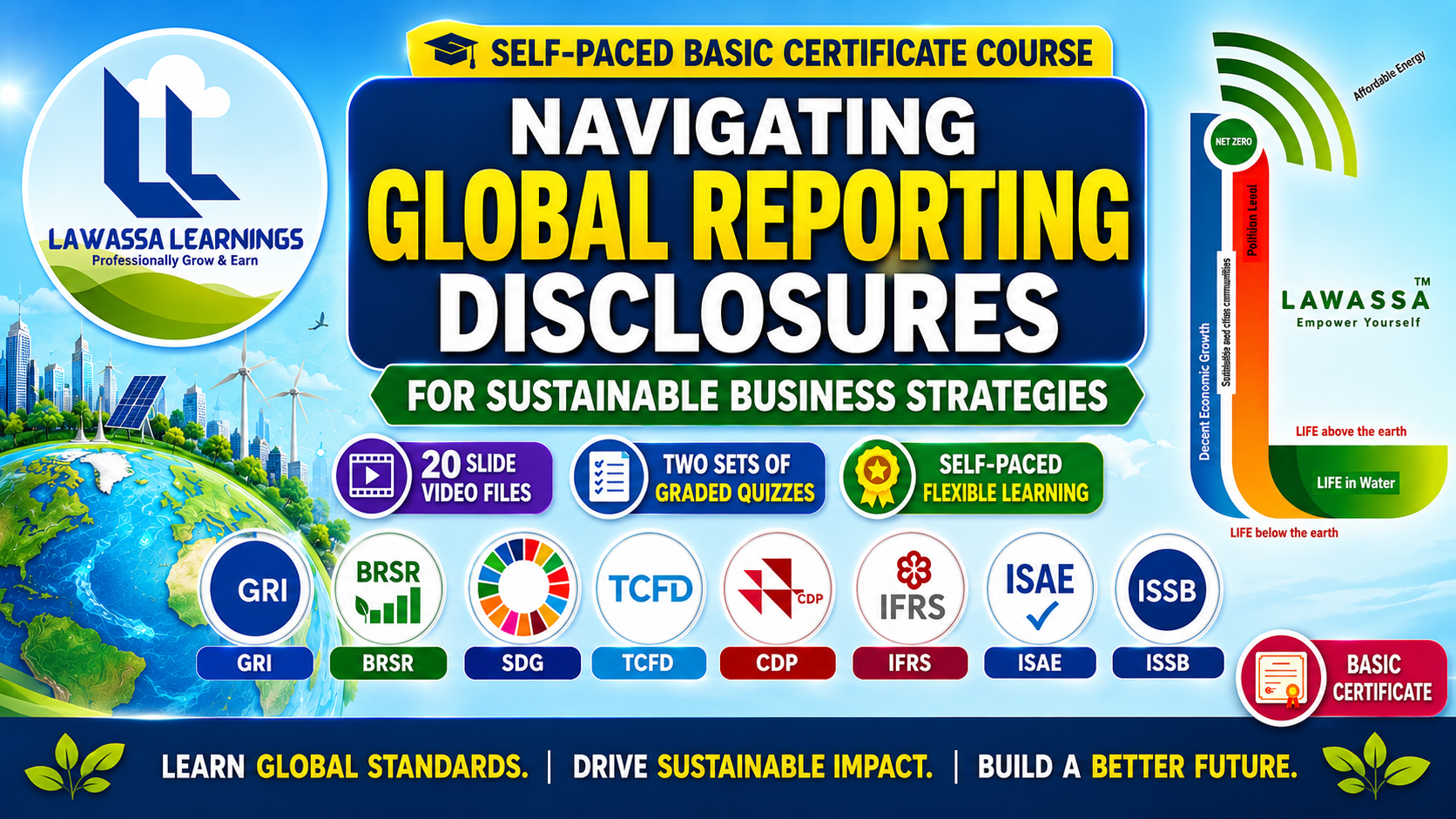
Unlock the future of sustainable business with our **Basic Certificate Course on Global Reporting Disclosures for Sustainable Business Strategies**. Designed for professionals, consultants, and aspiring ESG leaders, this course provides a structured understanding of globally recognized frameworks such as GRI, ISSB (IFRS S1 & S2), SASB, and TCFD.
Gain practical insights into evolving regulatory landscapes, including EU CSRD, India’s BRSR, and global ESG convergence trends. Learn how to interpret sustainability disclosures, align strategies with international standards, and enhance corporate transparency and stakeholder trust.
With a strong focus on real-world application, this course equips you to navigate complex ESG reporting ecosystems, integrate sustainability into decision-making, and create long-term value.
Step ahead in your professional journey—build expertise, credibility, and strategic advantage in the rapidly growing domain of global sustainability reporting.

Introduction : Module 1 Exploring Global Reporting Framework (Part 1)
1: Introduction
2: The ESG Reporting Universe at a Glance.
3: Core Sustainability Reporting Frameworks.
Slide 4: Climate-Specific Disclosure Frameworks
5: Integrated & Value Creation Frameworks.
6: Impact & SDG-Oriented Frameworks.
7: European Union: CSRD & ESRS.
8: United States, United Kingdom & India.
9: Other National & Regional Frameworks.
10: ESG Ratings, Benchmarks & Indices.

Introduction : Module 2 Exploring Global Reporting Framework (Part 2)
12: Emerging Trends in ESG Standardization.
13: The Double Materiality Lens.
14: The Global ESG Reporting Architecture.
15: Strategic Understanding (Consultancy Perspective).
16: Comparative Analysis of ESG Frameworks & Standards (Part-I).
17: Comparative Analysis of ESG Frameworks & Standards (Part-II).
18: Challenges of ESG Reporting Framework.
19: How to choose an ESG reporting framework?.
20: Conclusion: A Converging Landscape.

Summary & References
The global ESG reporting landscape has evolved from fragmented voluntary practices into a structured, regulated system integral to corporate strategy and governance. It now combines global frameworks, regional regulations, climate standards, and assurance mechanisms to enhance transparency and accountability. Frameworks like GRI emphasize stakeholder impact, while SASB and ISSB focus on financial materiality, reflecting a balance between inclusivity and investor relevance. Climate disclosures such as TCFD integrate environmental risks into financial reporting. Regulatory regimes like EU CSRD and India’s BRSR mandate comprehensive reporting using double materiality. Supporting systems, including ESG ratings and assurance standards, strengthen credibility. Despite challenges like data complexity and evolving regulations, ESG reporting is converging toward harmonized, technology-driven systems enabling sustainable value creation.
Instruction for quiz
· Students are advised to thoroughly review the course materials, as the majority of quiz questions are derived directly from the content.
· A minimum score of 80% is required in the graded quizzes of each module to qualify for the course certificate.
· Learners may attempt the quizzes as many as Three times as needed, progressing at their own pace until the certification criteria are successfully met.
· In the event of a retake, it is strongly recommended that students revisit and diligently study the course materials to enhance their understanding and improve performance.
· IF a student fails to complete the course within the allotted THREE attempts, repurchasing the course will be necessary to obtain the desired Basic-level certificate.
For executive, mid- and senior-level management and other related professionals responsible for ESG reporting, the global landscape now demands strategic, integrated, and compliant disclosures rather than fragmented voluntary efforts. Frameworks such as Global Reporting Initiative, Sustainability Accounting Standards Board, and International Sustainability Standards Board require balancing stakeholder impact with financial materiality. Climate frameworks like Task Force on Climate-related Financial Disclosures elevate environmental risks into financial decision-making, while regulations such as EU CSRD and India’s BRSR mandate structured, assured reporting. Leaders must strengthen governance, ensure high-quality ESG data, and align reporting with global standards to enhance transparency, investor confidence, and long-term value creation. Through simplified yet comprehensive modules, this basic certification course, aims to build a solid conceptual base, thereby preparing learners to engage with more advanced topics in sustainability. It serves as an essential stepping stone for those committed to impactful and future-oriented careers.