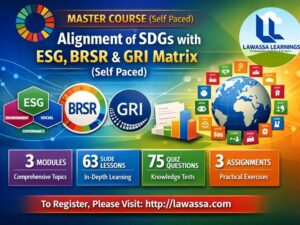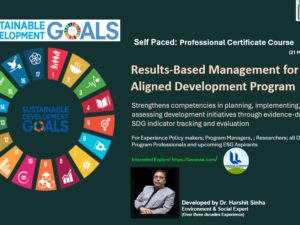

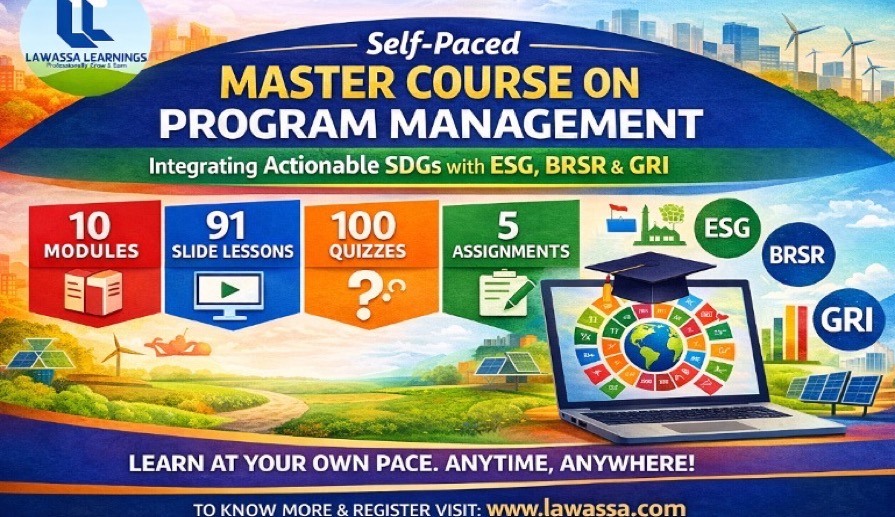
Program Management for Integrating Actionable SDGs with ESG, BRSR & GRI is a flagship Online Master Certificate Course by lawassa.com, designed for forward-looking professionals who seek to lead sustainability with precision, credibility, and measurable impact.
As global expectations around responsible business intensify, organizations require more than fragmented disclosures—they need structured program management capabilities that seamlessly align Actionable Sustainable Development Goals (SDGs) with ESG strategies, India’s BRSR framework, and GRI Standards. This course responds to that need with a rigorous, practice-oriented learning experience.
The programme equips participants with advanced tools to design, govern, and monitor integrated sustainability programmes, translate strategic intent into operational roadmaps, and ensure data-driven, compliant, and decision-useful reporting. Through expert-led modules, real-world case studies, and applied frameworks, learners gain the confidence to manage cross-functional ESG initiatives, strengthen stakeholder trust, and future-proof organizational value.
Ideal for sustainability leaders, ESG professionals, consultants, compliance teams, and senior managers, this master certificate goes beyond theory—empowering you to become a strategic enabler of impact, accountability, and long-term resilience.
Elevate your professional standing. Lead sustainability with structure. Create outcomes that matter—with lawassa.com.

1: Introduction
2: Why ESG Alone Is Not Enough
3: ESG and SDGs: Two Sides of the Same Sustainability Coin
4: Shared Values and Complementary Focus
5: Business Benefits of ESG-SDG Integration
6: Risk Mitigation Through SDG Alignment
7: Case Study: How Early ESG-SDG Adopters Outperform
8: Financial Outperformance: The Data Speaks
9: Step 1: Identify Priority SDGs Relevant to Your Business
10: Industry-Specific SDG Priorities

11: Step 2: Align ESG Initiatives with Selected SDGs
12: Practical Alignment Examples
13: Multi-SDG Integration Strategy
14: Step 3: Measure, Report, and Communicate Progress
15: The ESG-SDG Measurement Architecture
16: Integrated Reporting Framework Alignment
17: Common Barriers to Integration
18: Solutions and Best Practices
19: Real-World Example: A Multinational Tech Company's Journey
20: Lessons Learned from Integration Pioneers

Watch the Video for urther assignment related to SWOT Analysis

1: Introduction
2: Why Integrate SDGs into ESG?
3: Impact on Access to Capital and Market Position
Slide 4: The Sustainable Finance Revolution
5: Emerging Trends: Digital Tools and Collaborative Platforms
6: Collaborative Initiatives Accelerating Progress
7: The Regulatory Landscape: Mandatory ESG–SDG Disclosure
8: Call to Action: Embedding SDGs into Your ESG Strategy Today
9: ESG–SDG Integration Roadmap
10: Making It Real: Your First 90 Days
11: The Business Case Reinforced
12: Resources and Tools for ESG–SDG Integration
13: Essential Digital Platforms and Databases
14: Industry-Specific Guidance and Initiatives
15: Requirements to Build a Sustainable Future
16: Common Pitfalls to Avoid in ESG–SDG Integration
17: From Intention to Impact: Your Next Steps
18: Success Indicators: How You’ll Know It’s Working
19: Key Takeaways
Slide 20: Together, We Build a Sustainable Future
Summary Video Lesson
1: Introduction
2: Climate's Multi-SDG Impacts
3: Climate Metrics Hierarchy
4: Nature Climate Nexus
5: Integrating Social Equity into Climate Strategy
7: Supply Chain Labour Standards
8: Diversity, Equity & Inclusion
9: Human Rights Due Diligence
10: Community Relations & Social License
11: Board-Level Sustainability Oversight
12: Ethics, Integrity & Anti-Corruption
13: Transparency & Disclosure AND Data Privacy & Cybersecurity
14: Tax Transparency & Responsibility
15: Excellence Characteristics
16: Phase 1: Foundation Building (Months 1–6): Establishing Core Infrastructure
17: Phase 2: Strategic Integration (Months 7–18): Embedding into Strategy and Operations
18: Phase 3: Performance & Reporting (Months 19–30): Demonstrating Impact and Continuous Improvement
19: Case Study: Partnership Examples
20: Call to Action: Moving from Understanding to Impact
21: Conclusion: Integration as Strategic Imperative
SDG-ESG Framework Mapping
1: Introduction
2: Cross-Cutting BRSR Disclosures Supporting Multiple SDGs
3: Sector-Specific SDG Materiality Considerations
4: Measuring SDG Impact: From Outputs to Outcomes
5: Integrating SDG Mapping into BRSR Workflow
6:SDG Alignment Benefits: Beyond Compliance
7: Emerging Trends in SDG–BRSR Integration
8: Case Study Illustration: Manufacturing Sector SDG–BRSR Integration
9: Implementation Roadmap: Operationalising SDG–BRSR Alignment
10: Addressing Common Challenges in SDG–BRSR Mapping
11: Stakeholder Communication: Translating Technical Mapping into Compelling Narratives
12: Future of SDG–BRSR Integration: 2020 and Beyond
13: Key Recommendations for Practitioners
14: Conclusion: From Mapping to Movement
15: Moving Forward: Your SDG–BRSR Journey Begins
1: Introduction
2: Cross-Cutting G R I Universal Standards
3: G R I 200 Series: Economic Standards Overview
4: G R I 300 Series with Sciences based targets aligned with S D Gs
5: G R I 400 Series: Social Standards Overview
6: Priority Mappings by Industry Sector
7: Emerging Regulatory Frameworks and S D G Alignment
8: Materiality Assessment and S D G Prioritization
9: Common Reporting Challenges and Solutions
10: Assurance and Verification of S D G Reporting
11: Sustainability-Linked Finance and S D G Reporting
12: Best Practices in S D G–GRI Reporting
13: Conclusion: Strategic Value of S D G–GRI Integration
14: Implementation Roadmap for Organizations
15: Future Developments in S D G–GRI Alignment
Program Management is essential for converting sustainability commitments into measurable outcomes by integrating Actionable SDGs with ESG, BRSR, and GRI frameworks. It provides a structured approach to align organizational strategy with priority SDGs and translate them into coordinated ESG initiatives across environmental, social, and governance dimensions. Through effective governance, resource allocation, and risk management, program management ensures that sustainability actions are embedded within core business operations rather than treated as standalone activities.
By mapping ESG initiatives to GRI Standards, organizations achieve globally comparable and transparent disclosures, while alignment with BRSR ensures regulatory compliance and enhanced stakeholder trust, particularly in the Indian context. Program management enables consistency between action, performance measurement, and reporting by linking initiatives to clear KPIs and impact indicators.
Overall, program management acts as the strategic backbone that connects SDG ambition with ESG execution and BRSR–GRI reporting, enabling organizations to demonstrate credible impact, strengthen accountability, and support long-term sustainable value creation.
Instructions:
• Students are strongly encouraged to thoroughly review the course materials, as the majority of quiz questions are directly based on the provided content.
• A minimum score of 80% in the graded quiz of each module is mandatory to earn the course completion certificate.
• Learners are granted a minimum THREE attempts to successfully complete the Master level certificate course.
• In the event of a retake, students are advised to revisit the course content carefully to strengthen their understanding and improve their performance.
• IF a student fails to complete the course within the allotted THREE attempts, repurchasing the course will be necessary to obtain the desired Master-level certificate.
Advanced Program Management for Integrating Actionable SDGs with ESG, BRSR and GRI is a specialised learning pathway crafted for professionals with strong foundational expertise in sustainability and corporate reporting. Designed to go beyond introductory frameworks, this programme focuses on in-depth concepts, advanced methodologies, and strategic applications that enable learners to translate sustainability intent into measurable corporate outcomes.
The course is ideally suited for practitioners who possess professional knowledge of the **SDGs, ESG principles, India’s BRSR requirements, and GRI Standards**, and who are actively engaged in corporate action, governance, and disclosure. Emphasis is placed on program-level integration, performance alignment, materiality-driven decision-making, and value-linked reporting that strengthens credibility with investors, regulators, and stakeholders.
By mastering advanced program management techniques, participants enhance their ability to drive impact-led initiatives, improve reporting maturity, and elevate **corporate brand value** through transparent, outcome-oriented sustainability leadership. This programme empowers experienced professionals to lead with authority, precision, and strategic influence.