
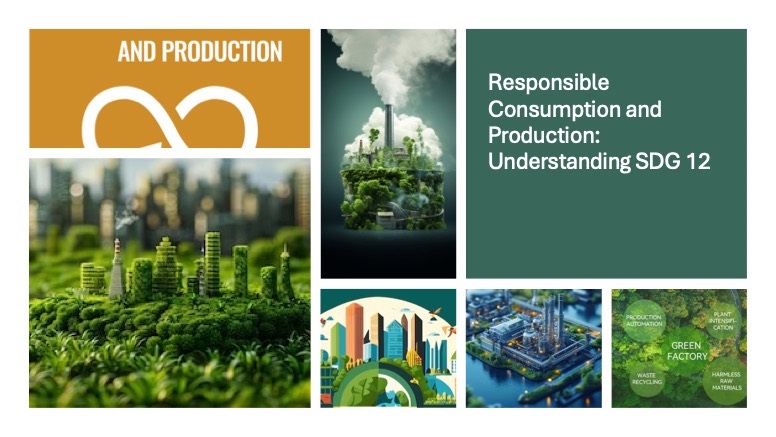
In an era marked by escalating environmental degradation, resource depletion, and unsustainable production cycles, Sustainable Development Goal 12 (SDG 12) emerges as a global imperative to restore balance between economic progress and planetary well-being. “Responsible Consumption and Production: Understanding SDG 12” is an exclusive online advanced certificate course designed for development practitioners, sustainability professionals, CSR and ESG specialists, and individuals aspiring to champion ethical resource management within organizations and communities.
This course offers an intellectually rigorous exploration of sustainable production frameworks, circular economy models, lifecycle assessment strategies, green supply chains, waste-to-value innovations, and climate-conscious consumer behaviour. Participants will gain enriched insights into international policies, corporate sustainability reporting standards, and transformative approaches that reduce ecological footprints while enhancing business efficiency.
By strengthening conceptual knowledge and sharpening analytical competencies, the course empowers professionals to design evidence-based interventions, measure sustainability outcomes, and steer organizations toward resource efficiency and low-carbon development. Learners will also gain exposure to real-world case studies, policy tools, and global best practices shaping responsible consumption and production.
Join this advanced certificate course and position yourself at the forefront of sustainability transition—where economic ambition aligns seamlessly with environmental responsibility and social equity.

1: Introduction
2a: The Significance of SDG 12
2b: Defining Sustainable Consumption and Production
3a: Global Success Stories in Sustainable Consumption and Production
3b: Global Consumption Patterns
3c: Global Production Challenges

4a: India's Consumption Landscape
4b: India's Production Challenges
5a: Challenges for India's SDG 12 Implementation
5b: India's Policy Response to SDG 12
6a: Innovative Indian Approaches
6b: Business Model Innovation
7: Financing Sustainable Consumption and Production
8: Measuring Progress: SDG 12 Indicators
9: Future Trends: What's Next for SDG 12
10: Key Takeaways: Accelerating SDG 12 Implementation
11a: Key Targets and Indicators of SDG 12
11b: SDG 12: The Imperative for Indicator-Based Assessment
12: Future Directions and Emerging Trends for SDG 12

Summary: Responsible Consumption and Production Understanding S D G 12
Sustainable Development Goal 12 (SDG 12) is a pivotal global commitment to establishing responsible consumption and production patterns that safeguard the environment while sustaining economic progress. It calls for a decisive departure from resource-intensive growth models and advocates a transition toward efficiency-led, ecologically sound systems. At its core, SDG 12 embodies the philosophy of achieving “more and better with less,” driving economic advancement without exacerbating ecological degradation, depleting natural resources, or compromising future generations.
The goal centres on decoupling prosperity from unsustainable resource exploitation by reducing food and material waste, curbing pollution, managing natural resources prudently, and nurturing circular economies based on reuse, recycling, and resource recovery. It also places equal responsibility on governments, industries, and consumers to adopt sustainability-oriented policies and behavioural practices rooted in environmental consciousness and accountability.
Across India and the wider world, the pursuit of SDG 12 presents both promise and complexity. Innovations in renewable energy, sustainable design, and waste-to-value models signal encouraging momentum, yet persistent infrastructure gaps, low awareness, and entrenched unsustainable habits continue to hinder progress. Advancing SDG 12 requires collective resolve—strengthened policy frameworks, industry-wide responsibility, informed consumer choices, and widespread sustainability education. Ultimately, responsible consumption and production pave the way for resilient economies, equitable societies, and a thriving planet grounded in harmony rather than compromise.
The Advanced Certificate Course on SDG 12: Responsible Consumption and Production is meticulously designed for learners possessing strong foundational knowledge and professional field experience in sustainability or SCP-related intervention projects. This intellectually demanding programme delves into the deeper architecture of SDG 12, unraveling advanced concepts such as resource-efficient production models, circular economy systems, green value chains, lifecycle assessment, sustainable procurement, and waste-to-resource innovations.
Participants will critically examine global and national policy frameworks, corporate sustainability reporting mechanisms, ESG compliance, and behavioural drivers shaping sustainable consumption patterns. Through analytical case studies, evidence-based methodologies, and practical toolkits, the course enhances participants’ ability to design, implement, and evaluate high-impact SCP strategies that accelerate SDG 12 outcome indicators.
This advanced learning pathway is ideally suited for professionals seeking to elevate their expertise and drive transformative sustainability outcomes across institutions, industries, and communities—where environmental stewardship, economic efficiency, and social well-being intersect.