
SDG 4: Quality Education – Global Progress and Challenges
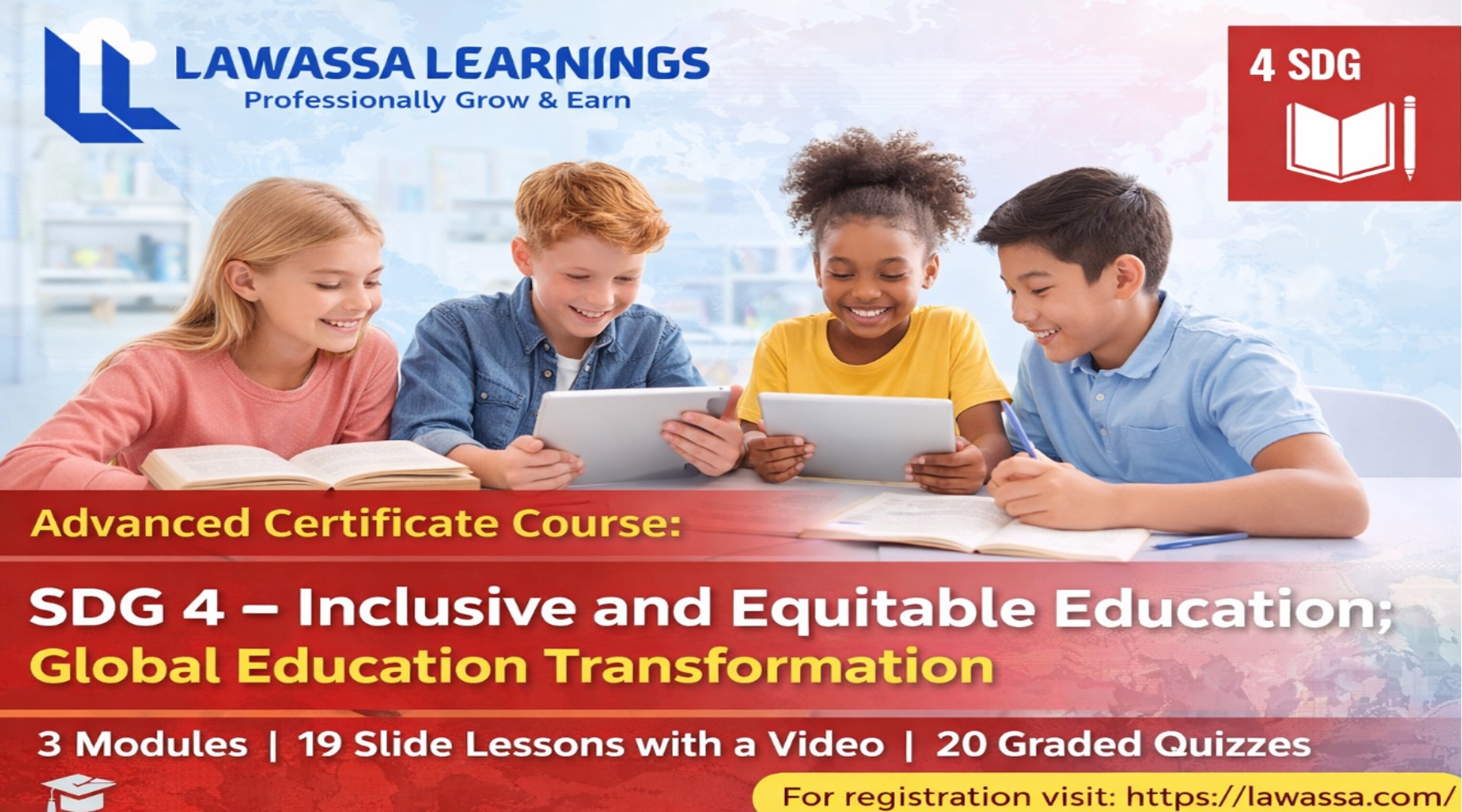
Advanced Certificate Course
Quality education is the foundation upon which inclusive growth, social mobility, and sustainable development are built. This advanced online certificate course invites dedicated educators, development practitioners, policy analysts, and sectoral leaders to deepen their mastery of the global education landscape through a highly analytical and practice-oriented learning journey.
Grounded in the principles of Sustainable Development Goal 4, the course offers a sophisticated exploration of educational equity, learning outcomes, digital transformation, teacher capacity development, early childhood education, and skills for employability in the 21st century. Learners will critically examine global disparities, systemic barriers, and the persistent learning crisis that affects millions, while also unpacking transformative solutions that drive measurable progress.
Designed for professionals with strong prior exposure to education or development initiatives, the programme enhances strategic thinking and strengthens competencies in data interpretation, programme design, and outcome-based evaluation. Participants will engage with global case studies, policy frameworks, and innovative models that address both progress and pressing challenges in achieving SDG 4.
Join this intellectually enriching course to elevate your expertise, advance your professional impact, and contribute to shaping equitable, resilient, and future-ready education systems worldwide.

1: Introduction
2: Understanding SDG 4: Core Targets
3: The Global Education Landscape
4: Quality Education in Nordic Countries: Lessons for India
5: Education in East Asia: Achievement Through Rigor
6: Vocational Education and Current status of Quality Education in India

7: National Education Policy 2025: India's Transformation Plan
8: Regional Disparities in Indian Education
9: Case Study: Kerala's Education Success
10: Gender and Education: Progress and Persistent Gaps
11: Teacher Quality: The Critical Factor
12: Education Promise and Pitfalls with financial Limitations
13 COVID-19 Impact on Global Education
14: Education for Sustainable Development
15: The Path Forward: Key Recommendations
16: The Seven Targets of SDG 4: A Comprehensive Framework
17: Key Performance Indicators for SDG 4 Assessment
18: Measuring Learning Outcomes: Beyond Enrolment Numbers in SDG 4
19: The Path Forward for SDG 4: Recommendations and Future Directions

Summary
S D G 4: Quality Education - Global Progress and Challenges:
Sustainable Development Goal 4 (SDG 4) embodies a universal commitment to deliver inclusive, equitable, and high-quality education for all by 2030. Recognised as an inherent human right, education functions as a catalyst for sustainable development—fuelling economic advancement, stimulating innovation, and mitigating poverty and inequality across societies.
Although notable strides have been made, including historic gains in primary school enrolment and significant improvements in gender parity, the global trajectory toward SDG 4 remains uneven. Expanding digital learning ecosystems, progressive curricular reforms, and increased national education investments have enhanced access and strengthened systemic capacity. Initiatives such as digital classrooms, community learning hubs, and skill-oriented programmes continue to demonstrate promise in narrowing accessibility divides.
Yet formidable challenges persist. Stark regional inequities endure, particularly in sub-Saharan Africa and conflict-affected regions, where out-of-school rates remain alarmingly high. The COVID-19 pandemic deepened an existing learning crisis, resulting in severe learning losses and increased dropout rates—strains from which many systems have yet to fully recover. Even among enrolled learners, the quality of education is a pressing concern, with millions lacking foundational literacy and numeracy. Chronic shortages of trained teachers, inadequate infrastructure, and persistent underfunding further hinder progress.
Realising SDG 4 demands urgent, scaled-up investment, innovative delivery models, and targeted interventions for the most marginalised. Renewed political commitment and global cooperation are indispensable to ensuring that quality education becomes a lived reality for every learner and to sustaining momentum toward the broader 2030 Agenda.
This Advanced Certificate Course on SDG 4: Quality Education – Global Progress and Challenges is designed for learners with substantial prior knowledge and professional experience in education intervention projects. The programme offers a deeply analytical exploration of the global education landscape, enabling participants to refine their expertise in advancing equitable and high-quality learning outcomes.
Through rigorous, research-informed modules, learners will engage with advanced concepts such as inclusive education frameworks, competency-based curricula, digital learning ecosystems, teacher capacity development, and systemic approaches to strengthening learning outcomes. Emphasis is placed on interpreting education indicators, evaluating programme effectiveness, and designing evidence-based strategies aligned with national and global SDG 4 commitments.
Targeted at seasoned practitioners and development professionals, this course provides an opportunity to enhance technical proficiency, sharpen strategic thinking, and contribute meaningfully to improving educational equity and quality. Participants will emerge equipped to drive transformative solutions and elevate outcome indicators within diverse educational contexts.